The Engineering Leader's AI Adoption Playbook
The Engineering Leader's AI Adoption Playbook
TierZero agents automate production engineering at companies like Discord and Drata that are pushing code faster than ever. The patterns in this guide are drawn from real-world deployments.
From Coding Agents to Production Agents
Code Got Faster. Production Stayed the Same.
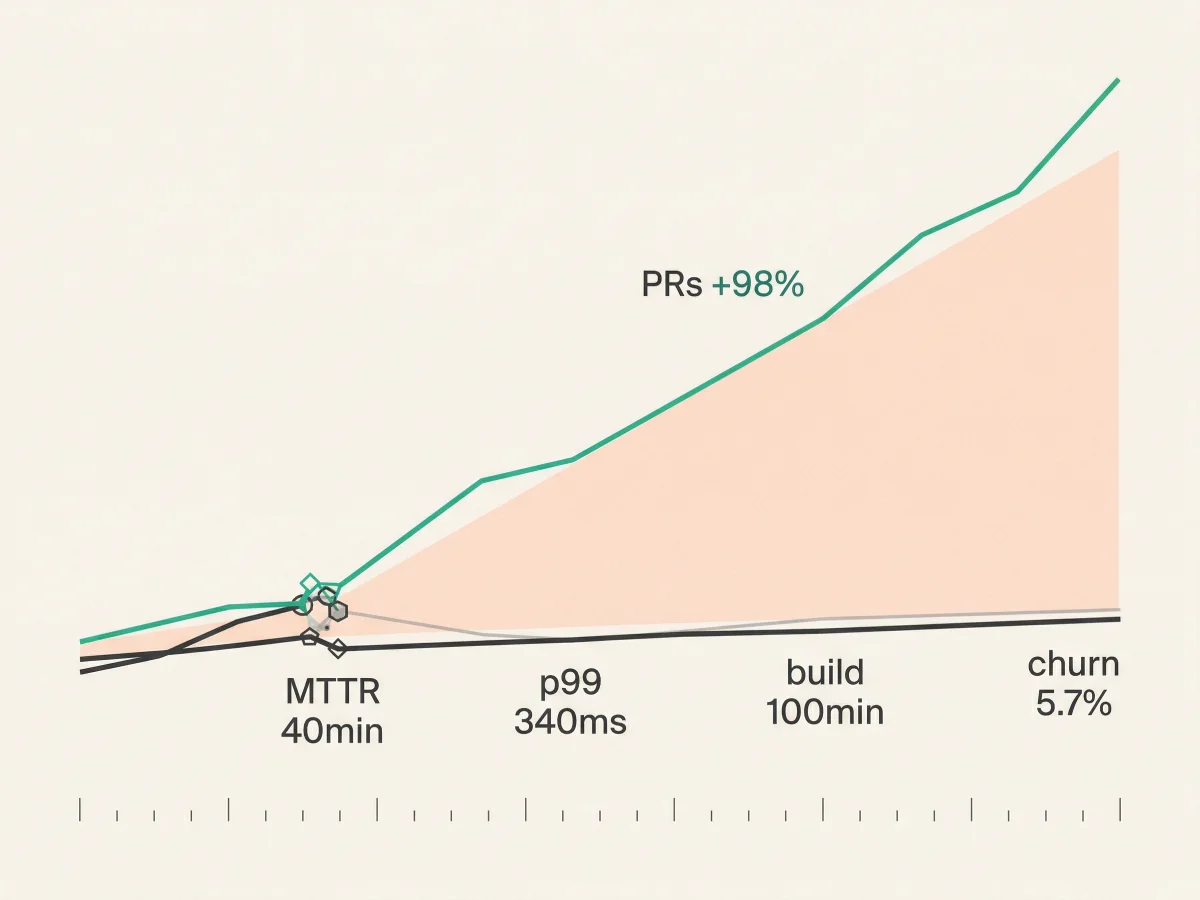
Your on-call engineer gets paged at 2 AM. Latency spike on the checkout service. They open the observability stack and see 150 commits to this service in the past week. Six months ago that number was 20. Several of those commits contain AI-generated code humans only glanced at. Someone on the team prompted an agent, skimmed the diff, and hit merge.
They look for custom metrics on the new endpoints. Nothing. No traces, no monitors. They spend 40 minutes grepping logs before finding the first clue. Six months ago this would've been a 10-minute fix because the person who wrote the code actually understood it.
Every engineering org that adopted coding agents is living some version of this. Code output doubled. Deployments doubled. But the production side of the house didn't change at all. Your most expensive engineers now spend a third of their time firefighting code nobody understands instead of shipping product. Incidents drag on because the person who merged the PR can't explain the logic. Senior people burn out and quit. At any company with more than a few software engineers, this is already a meaningful cost per year.
DORA 2025 data confirms it at industry scale: AI adoption positively correlates with throughput and negatively with stability. DX's research across 435 companies and 135k developers found the same thing from a different angle: AI usage increased 65% while PR throughput grew just 10%. The bottleneck didn't disappear. It migrated downstream to code review, testing, deployment, and production ops.
Over 90% of Fortune 100 companies have adopted AI coding tools. Almost none of them have figured out the post-deploy reality.
Code got faster. Production stayed the same.