Multi-Agent AI Systems Fail on State, Not on Reasoning
Multi-agent AI failures look like reasoning bugs but most are state bugs. The three coordination failure classes breaking production agents and how to fix them.

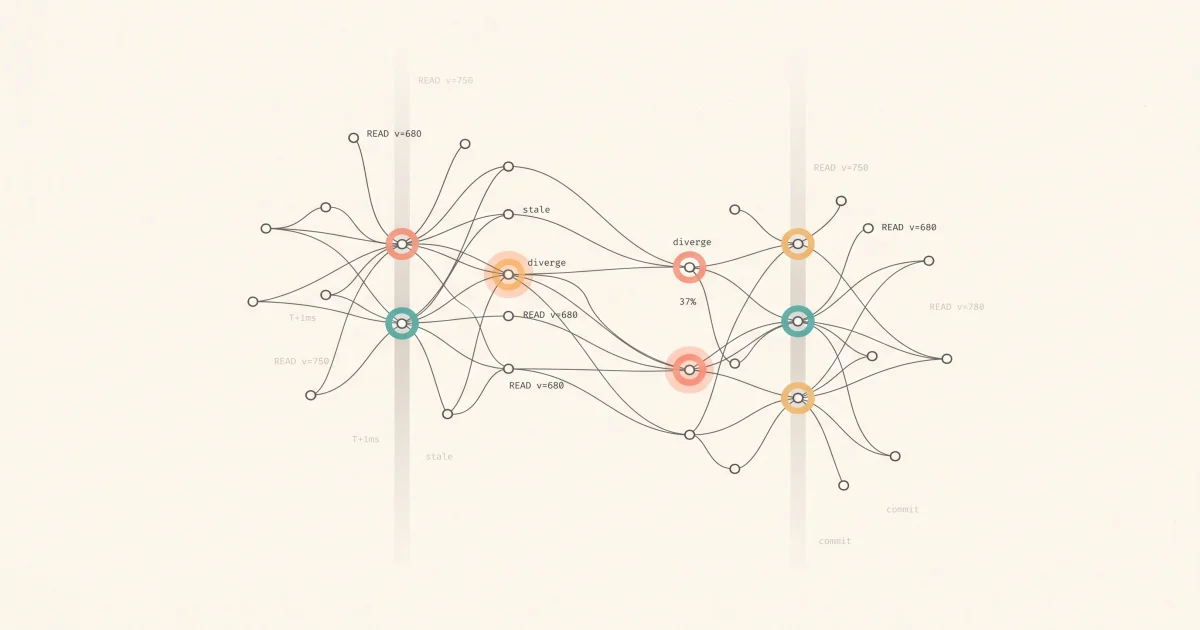
37% of multi-agent AI failures aren't reasoning errors. They're state failures: stale reads, divergent views, and orphaned mutations that traditional monitoring cannot detect.
Yugabyte launched Meko this week, an open source data infrastructure aimed at the most boring problem in agentic AI: state. Not models. Not orchestration. Not frameworks. State.
The launch came with a number that should reframe how every engineering leader thinks about multi-agent reliability. According to the MAST failure taxonomy from UC Berkeley's Sky Computing Lab, roughly 37% of multi-agent system failures are coordination failures. That category is dominated by state synchronization: agents acting on stale, partial, or divergent views of shared data.
These are not reasoning failures. The model did not get dumber. The data underneath it got incoherent.
Key Takeaways
- 37% of multi-agent failures are coordination failures, dominated by state synchronization. They look like reasoning failures and get misdiagnosed as model quality issues.
- Three classes of state failure break production multi-agent systems: stale reads, divergent views, and orphaned mutations.
- Multi-agent LLM systems fail at rates between 41% and 86.7% in production. Fewer than 10% of teams with AI agents successfully scale past single-agent deployments.
- Event logs cannot debug coordination failures. Decision traces, capturing intent plus context plus outcome, are the minimum forensic record.
- State coherence is the architecture, not an implementation detail the agents work out at runtime.
What 37% of Multi-Agent Failures Actually Are
The MAST paper from Cemri et al. at UC Berkeley defined the first systematic taxonomy of multi-agent system failures. They analyzed over 1,600 execution traces across seven popular multi-agent frameworks and grouped 14 failure modes into three categories.
Coordination failures came in at 36.94%. Industry analyses tracking the same phenomenon in production environments estimate state synchronization issues account for roughly 40% of multi-agent breakdowns. Different methodologies, same diagnosis.
| Metric | Number | Source |
|---|---|---|
| Multi-agent failures classified as coordination failures | 36.94% | MAST 2025 |
| Multi-agent failures classified as specification problems | 41.77% | MAST 2025 |
| Multi-agent failures classified as verification gaps | 21.30% | MAST 2025 |
| Reported failure rates for multi-agent LLM systems in production | 41% to 86.7% | Augment Code 2026 |
| Companies with AI agents in production | 57% | G2 Enterprise AI Agents Report 2026 |
| Companies that scale beyond single-agent deployments | Less than 10% | G2 2026 |
| Distinct failure modes catalogued in MAST | 14 | MAST 2025 |
| Multi-agent frameworks evaluated | 7 | MAST 2025 |
The distribution is the most important fact in that table. No single category dominates. Specification, coordination, and verification are roughly evenly split. That means three different things break, and they break for three different reasons. Treating multi-agent reliability as a model-quality problem misses two thirds of the failure modes by construction.
Three Ways State Breaks Multi-Agent Systems
Stale Reads
Agent A modifies a shared fact. Agent B, operating in parallel or downstream, reads the older version because it pulled from a cache, queried before the write was committed, or accessed a replica that had not synchronized yet. A widely cited example: a credit scoring agent writes a score of 750 to the database. A risk assessment agent operating from cache reads the previous score of 680 and approves a transaction that should have been flagged. Nothing in the agent's reasoning was wrong. Its inputs were.
Divergent Views
Two agents query the same data system at slightly different moments and reach different conclusions about the same production state. One sees the database before a migration completed. Another sees the same database mid-transaction. A third sees it after rollback. Each reasons correctly from what it observed, but the system as a whole produces inconsistent decisions because no two agents are looking at the same world.
Orphaned Mutations
An agent starts a state change, fails partway, and leaves production in a half-changed state nobody knows about. The next agent that reads the affected resource sees a state that should not exist according to any single workflow. Without a transactional boundary that wraps the entire multi-step mutation, partial writes are inevitable and recovery requires forensic archaeology.
These are not edge cases. They are what happens when concurrent agents act on shared state without a memory consistency model. Karthik Ranganathan, co-CEO of Yugabyte, framed it in plain language: "It is the state. It is very difficult to manage the state and keep it on point and actually transfer everything."
Why the DIY Data Stack Stops Working
Most teams building multi-agent systems start with what they already know. A relational database. A vector store. Object storage. Each tool is good at one thing.
The relational database holds canonical facts. The vector store holds embeddings for retrieval. Object storage holds artifacts and intermediate outputs. Single-agent systems can paper over the seams between these stores because one agent reads and writes serially. Multi-agent systems cannot.
Ranganathan's framing of the architectural shift: "Before, we used to just take a Postgres database and try to figure out the optimal way to lay out data. Now we have a Postgres database and a graph database and a vector database. The problem complexity has gone up by a few orders of magnitude."
The complexity is not just operational. It is conceptual. Three data systems mean three consistency models, three failure modes, three sources of staleness. When agents disagree about the state of the world, the question "which store has the right answer?" rarely has a clean answer.
Why This Looks Like a Reasoning Problem
State failures present as reasoning failures. The agent produces a wrong answer. The natural response is to look at the prompt, the model, the tool definitions, and the orchestration logic. Almost none of that gets at the actual cause.
That is the diagnostic trap. Production teams running multi-agent systems will spend weeks tuning prompts and swapping models when the underlying issue is that two agents are operating on different versions of the same fact. The symptoms are downstream of the data layer, but the data layer is invisible to the debugger looking at the trace.
This is also why these failures are silent. No exception fires. No alert triggers. The agents complete their tasks, return outputs, and move on. The customer experience degrades because decisions were made on inconsistent inputs, but nothing in the system flagged the inconsistency. The MAST research calls this the "non-deterministic, opaque" failure profile of multi-agent systems. It is exactly what makes them so hard to operate.
Decision Traces, Not Event Logs
Conventional event logs were designed for traditional applications. Request comes in. Response goes out. Log captures both. For multi-agent systems running asynchronous, partially overlapping workflows, that contract is not enough.
What you need is what Ranganathan described as a "decision trace": a record of what an agent planned to do, why, the context it evaluated, the policy that authorized the action, the boundaries it operated within, and what actually happened. The same forensic structure described in the Intent-to-Execution Evidence Chain work from earlier this year, applied to multi-agent coordination instead of single-agent action.
The difference matters. Event logs can answer "did this happen?" Decision traces can answer "should it have, and what did the agent see when it decided?" In a multi-agent failure, the second question is the only one that helps.
What This Costs at Production Scale
The cost compounds. Multi-agent systems already pay a transport tax of up to 15x the tokens of a single-agent setup. Layer state failures on top, and the failure budget runs out fast.
Teams burn engineering time chasing reasoning bugs that are actually coordination bugs. They restart agents that are not malfunctioning, just operating on stale state. They lose customer trust to silent inconsistencies that no monitoring tool surfaced. The most expensive part is not the wasted compute. It is the engineering hours spent fixing the wrong layer.
This is the same operational pattern that turns traditional incident response into a fragmented, all-hands fire drill. Production engineering teams responsible for multi-agent reliability need investigation tooling that traces a failure across agent boundaries, retrieved context, and shared state, not just within a single agent's execution.
What to Do This Week
-
Pick a memory consistency model and document it. Linearizability is expensive but predictable. Snapshot isolation is cheaper but requires careful read semantics. Eventual consistency works for some workflows and ruins others. Whichever you pick, write it down. "We did not pick one" is the worst answer.
-
Replace event logs with decision traces for any agent that mutates shared state. Capture the intent, the context evaluated, the policy decision, the boundaries, and the outcome. If your agents are restarting services, modifying configs, or making customer-facing decisions, the audit gap on coordination failures is not survivable.
-
Add divergence detection to your shared memory layer. When two agents observe the same fact at the same moment, they should agree. If they do not, something needs to halt and surface the inconsistency before it becomes a customer incident.
-
Wrap multi-step state mutations in explicit transactional boundaries. Orphaned mutations come from agents that started writes, failed, and left no record. Make the start and end of every multi-step mutation observable.
-
Stop tuning prompts for failures that look like coordination problems. If the same agent gets the right answer in isolation but the wrong answer when it runs alongside another agent, the prompt is not the problem. Look at what each agent observed, when, and whether they agreed.
The Real Lesson From the Yugabyte Launch
The pattern Yugabyte is naming is not new. Distributed systems have been wrestling with state coherence across concurrent actors for fifty years. What is new is that LLM-powered agents are now the concurrent actors, and most teams building with them treat the data layer as something that just needs to be there, not as the architecture.
In the next year, every multi-agent framework will ship a memory layer. The teams that win will be the ones that treated state as the architecture from day one and built their observability, evaluation, and incident response around coordination failures, not just reasoning quality. The teams that keep blaming the model will keep replacing prompts and frameworks while their agents continue to disagree about basic facts in production.
The 37% number is a wake-up call. The harder fact behind it is that the failure mode was always going to be in the data layer. We just kept looking at the model.
Why are most multi-agent system failures misdiagnosed as reasoning failures?
Coordination failures present as wrong outputs from individual agents. The natural debugging response is to look at the prompt, the model, or the orchestration logic. The actual failure is in the data layer: stale reads, divergent views, or orphaned mutations. The symptom is one layer up from the cause, which is why teams spend weeks tuning prompts when the fix is in the memory and consistency model.
What does it mean to treat state as architecture in multi-agent systems?
Treating state as architecture means picking an explicit memory consistency model, designing your agents around what that model guarantees, and building observability that surfaces inconsistencies the moment they appear. The opposite is treating state as something the agents work out at runtime, which is what produces the silent coordination failures the MAST research catalogued.
How does the MAST taxonomy categorize multi-agent failures?
The MAST taxonomy from UC Berkeley analyzed over 1,600 traces across seven multi-agent frameworks and grouped 14 distinct failure modes into three categories: specification and system design (41.77%), inter-agent misalignment, also called coordination failures (36.94%), and task verification (21.30%). State synchronization issues fall within coordination failures. The roughly even distribution across the three categories means there is no single fix.
Are multi-agent systems ready for production?
Most are not. Industry data shows 57% of companies have AI agents in production but fewer than 10% successfully scale beyond single-agent deployments. Reported failure rates for multi-agent LLM systems range from 41% to 86.7%. Multi-agent reliability requires intentional design of state, coordination, and observability. Without that, multi-agent systems multiply failure surfaces faster than they multiply capability.
What is the relationship between context engineering and multi-agent state management?
Context engineering is how a single agent decides what to remember, retrieve, and forget across a long-running session. Multi-agent state management is how several agents share, synchronize, and reconcile that context across each other. The first prevents an agent from contradicting itself. The second prevents two agents from contradicting each other. Both are required for a multi-agent system that holds together in production. See our analysis of context engineering for production agents for the single-agent foundation.
Production Agents That Stay Coherent
TierZero Production Agents handle production work across observability, code, incident management, and tribal knowledge with a Context Engine designed for state coherence. Decision traces for every action, evidence chains across every investigation, and explicit memory consistency. Not a black box. Not a stale read away from a customer incident.
Co-Founder & CEO at TierZero AI
Previously Director of Engineering at Niantic. CTO of Mayhem.gg (acq. Niantic). Owned social infrastructure for 50M+ daily players. Tech Lead for Meta Business Manager.
LinkedIn